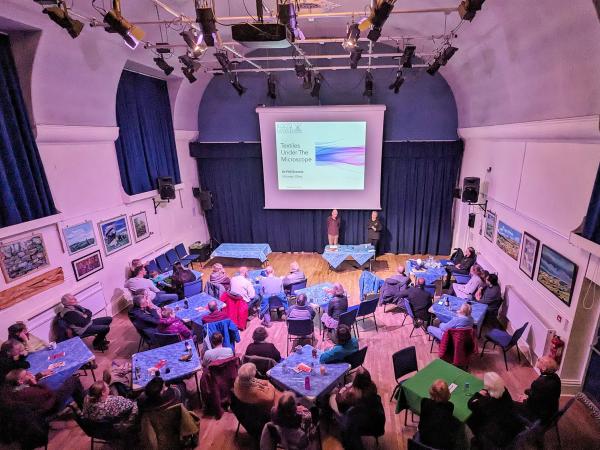
Our regular Science Café returns once more with a veritable cornucopia of science.
Each speaker has a quarter of an hour to talk, then you, the audience, take over. Whether you want to grill the speaker about generalities or pose a particular problem, the floor is yours.
Our café is just the place to sample some new science - and something from the bar!
Students in full time education are FREE.
Frontier Science - drones, Romans and river crossings
Dr Kayt Armstrong, Department of Archaeological & Forensic Sciences, University of Bradford
How did the Romans cross the river Tweed? With the mobile laboratory she manages, Dr Kayt Armstrong and a team of intrepid archaeologists from Bradford are off to the edge of the Roman Empire to find out. As Kayt says, “February is a risky time for fieldwork but we should be ok!” Will their hunt for a bridge prove successful? Come to the Science Café to find out!
The Good, the Bad and the Leaky: growing blood vessels on-a-chip to model cancer drug delivery
Georgina Lee, School of Physics & Astronomy, University of Leeds
My talk will focus on how organ-on-chip is becoming an alternative to animal models, as well as the current drawbacks. I will also touch briefly on my research, which is specific to growing
Weather forecasting with AI
Prof. Doug Parker, School of Earth & Environment, University of Leeds
Over the past 3-4 years, AI-based weather prediction models have achieved the same levels of accuracy that "physics-based" models took 60 years to attain, using a fraction of the computational cost. We don't know if this progress will continue, or whether all models have nearly reached a natural limit of prediction skill due to the mathematics of chaos.
Although the rise of AI models has surprised many scientists, it can be viewed more simply as a return to ideas of statistical and analogue weather prediction, which had been largely abandoned in the 1970s as physics-based models advanced.
Many claim that AI weather prediction will democratise weather prediction, but is it more likely to drive forecasting away from the public sector weather services and into the hands of global corporates?